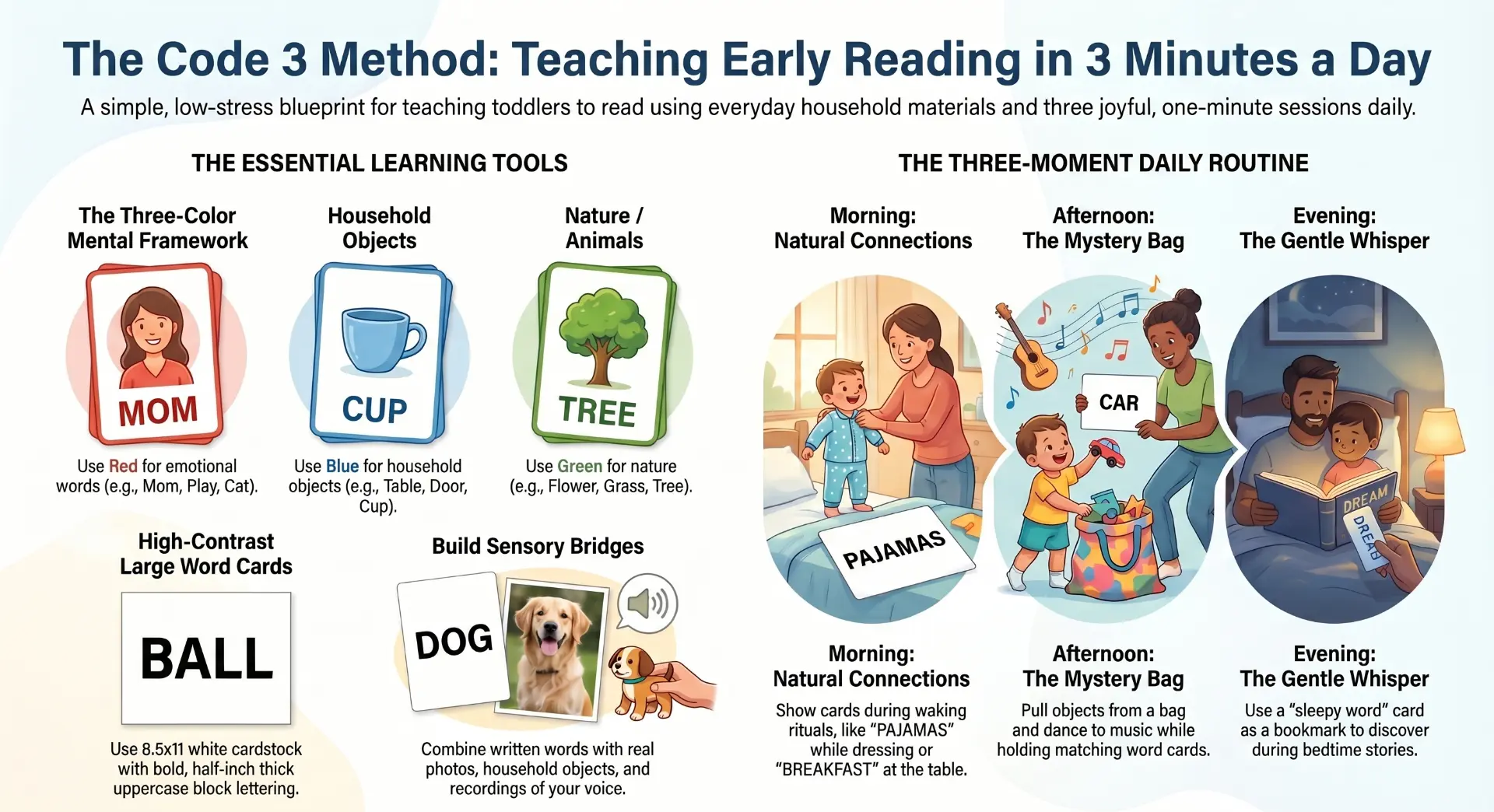
The Beginning of a Superpower
From the Code 3 course book · Claudia
In this chapter
“Is it too early?”
That’s the question I hear most often.
But beneath that question lies another one many parents are really asking themselves:
What if I could give my child a real advantage… without taking away their childhood?
My name is Claudia. I’m an elementary school teacher, and for years I’ve been searching for the answer to that question.
Every morning, before the children arrive, I place their notebooks neatly on their desks. It’s a simple habit, but to me it feels almost like a ritual. And every day I ask myself the same thing:
Is it possible to spark the wonder of learning earlier? Could we borrow a little of that magic from the future and offer it to children sooner?
That question eventually led to the creation of Code 3—a method designed to guide you, step by step, through a remarkable journey: helping your child begin reading as early as age three in a way that feels playful, natural, and joyful.
But Code 3 is more than a method.
It’s the doorway to a complete learning program created specifically for families like yours.
And this project was never the work of one person alone. Behind it is a team of elementary teachers, psychologists, and education specialists, each bringing their own expertise and perspective.
The meeting of these different disciplines is what made Code 3 practical, effective, and adaptable for any family.
When I First Saw the Possibility
The first time I realized how powerful this idea could be, I was still a student teacher.
I was observing preschool children playing with wooden blocks. They lined them up in patterns, stacked them carefully, and smiled when they discovered that every shape seemed to “match” something else.
Watching them, it felt as if their brains were naturally trying to decode the world.
Scientists call this moment a synaptic window—a period of intense brain plasticity that peaks around 36 months of age.
It’s almost as if, at that stage, a child’s brain is saying:
Give me symbols. Give me stories. I’m ready.
Imagine your child’s brain like a network of tiny paths through a forest.
Every word they hear… every sound connected to an image… every story that sparks their imagination…
Those small paths begin to widen into bright roads capable of carrying them far.
I remember watching a video during a professional training seminar. A colleague showed her daughter standing in the kitchen, reading the word cat from a red flashcard. Then the little girl pointed to the family cat sleeping beside the dishwasher.
It wasn’t memorization.
It was understanding.
Symbol. Sound. Meaning.
All connected in a single moment.
I remember thinking:
This is possible. Families can experience this.
And that realization changed the direction of my work.
Building the Method
From that moment on, I began studying, experimenting, and learning from both successes and mistakes.
I drew inspiration from classic early-reading approaches and combined them with tools from psychomotor learning, theater games, and motivational psychology.
Slowly, a simple but powerful framework began to take shape— one that transforms everyday playtime into fertile ground for learning to read.
A Question Every Parent Asks
At this point, you might be wondering:
“Am I pushing my child too hard?”
I asked myself the same question when I first began exploring this idea.
But there’s something important to understand: Code 3 doesn’t force anything.
It doesn’t rush children. It doesn’t pressure them.
Instead, it responds to a natural human impulse: the desire to name the world.
When a child points to the sky and says “sun,” they’re not doing it because someone told them to. They’re doing it because they’re hungry for meaning.
And as adults, we can nurture that curiosity.
Not with anxiety or pressure—but with words, images, and connections.
A Moment I’ll Never Forget
During one workshop with parents and children, a boy who was two years and eleven months old walked up to me holding a small book and said, “Cia-cia.”
His mother explained that he was asking for a story called The Singing Sunflower.
I showed him the title and said, “Look—this word says sunflower.”
He repeated it slowly:
“Sun… flow… er.”
Then he pointed to a flashcard he had seen the day before.
He had made the connection.
The pride in his eyes was unmistakable. That single moment was worth an entire book.
A Personal Story
My curiosity eventually led me to try the approach with my own son, Willy, when he was just over two years old.
After three months of simple exercises, he was already well on his way to reading.
Today he is 24 years old and a college graduate.
He wasn’t a prodigy—just a normal child who, when given the right kind of stimulation, learned to read at age three.
What surprised me most was how that early experience seemed to support other cognitive abilities as well—from logical reasoning to comprehension and memory.
How Code 3 Works
You won’t find unnecessary technical jargon in these pages.
I’ll explain mirror neurons the way I would tell a story. I’ll introduce phonemes through simple games you can play right on your living-room floor.
You’ll also discover variations designed for different learning styles—visual, auditory, and tactile—so every child can find the path that suits them best.
Why This Method Works
In addition to my daily work in the classroom, I’ve guided more than 150 families through the Code 3 approach.
We carefully tracked the results.
Here’s what we observed:
- After 4 months, 92% of children recognize at least 20 words.
- After 6 months, 68% can read short sentences—while continuing to enjoy imaginative play.
These aren’t miracle promises.
They’re consistent results supported by practical tools that families can use at home.
A Simple Adjustment That Changed Everything
Once, a mother told me:
“My daughter loses interest after two weeks.”
She was right. Their sessions lasted five minutes, the same words were repeated every day, and the tone was flat.
So we made a few small changes.
We shortened the sessions to twenty seconds, introduced new words each day, and added playful gestures and silly expressions.
One week later, the little girl was the first to ask for the reading game.
Your Energy Matters Most
You don’t need to be a teacher or a speech therapist.
What matters most is becoming your child’s partner in discovery.
Sometimes it means allowing yourself to be a child again—even if just for a moment.
Do you remember the first time you opened a book and realized you could read it on your own?
That sense of freedom?
Code 3 is the bridge that connects that memory to your child’s present.
And it makes that experience possible every day.
In my classroom, we even play a game I call “The Face of Words.” Children draw eyes and a mouth on words to bring them to life.
Ready to Begin?
Here’s how the journey ahead is organized:
Chapter 1: What happens in the brain at age three—and why it’s the perfect time for learning. Chapter 2: How to turn your home into a sensory learning space—without spending money. Chapter 3: The five stages of the Code 3 method, explained clearly. Chapter 4: How to handle distractions, different learning styles, and skeptical opinions. Chapter 5: How early reading strengthens creativity, empathy, and logical thinking.
Now close your eyes for a moment.
Picture yourself sitting beside your child, holding a colorful card with a single word on it.
Maybe that word is wonder.
You say it together.
And in your child’s eyes, that word begins to shine.
That’s where the real journey begins.
And I’m honored to walk beside you.
SECRET #1
Enthusiasm Without Anxiety
Three minutes a day of shared curiosity and consistency are far more powerful than a hundred hours of boring drills.